


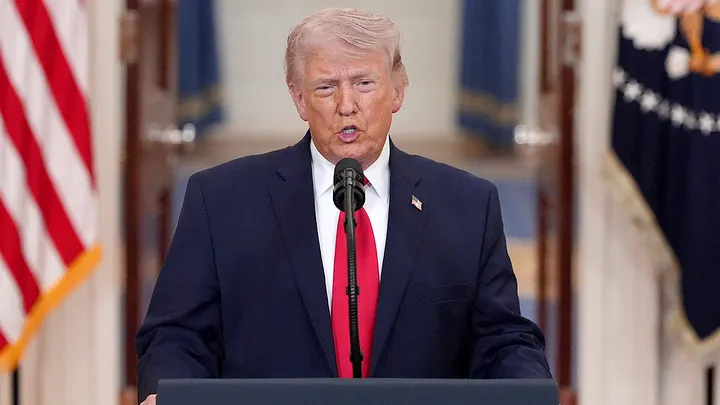
In a highly anticipated national address on Wednesday night, U.S. President Donald Trump announced what he described as a major turning point in U.S. foreign policy and military operations in the Middle East.
Speaking after 32 days of what he called “Operation Epic Fury,” Trump told Americans that Iran has been significantly weakened and no longer poses a major threat to the United States.
His remarks, however, have already begun to stir global reactions, raising questions about the true state of the conflict and what comes next.
What Is Operation Epic Fury”?
Although not officially detailed in full, “Operation Epic Fury” appears to refer to a sustained U.S. military and strategic campaign targeting Iranian capabilities over a 32-day period.
Trump framed the operation as:
- A decisive show of strength
- A preemptive move to neutralize threats
- A mission nearing completion
While specifics remain unclear, the scale and tone of his address suggest a coordinated effort involving intelligence, military precision, and economic pressure.
Key Takeaways from Trump’s Address
1. Iran “No Longer a Threat”
The most headline-grabbing moment came when Trump declared:
“Iran is no longer a threat after 32 days.”
According to him, the operation successfully dismantled critical elements of Iran’s ability to challenge U.S. interests.
This statement is significant, given Iran’s long-standing role as a major geopolitical player in the Middle East. However, analysts may question whether such a claim reflects reality or political positioning.
2. “We Hold All the Cards”
Trump reinforced the idea of U.S. dominance by stating:
“We hold all the cards. We are very close to finishing the job.”
This suggests that:
- The U.S. has strategic leverage
- Iran may be in a weakened negotiating position
- The conflict could soon reach a final phase
Still, Trump did not clarify what “finishing the job” would entail—whether it involves diplomacy, further military action, or sanctions.
3. Operation Nearing Its Final Stage
Throughout the address, Trump repeatedly emphasized that the mission is almost complete.
This raises key questions:
- Is there a final strike or agreement pending?
- Will there be a formal declaration of victory?
- Or could tensions escalate again?
The lack of detail leaves room for speculation.
4. Rising Gas Prices Explained
Trump also addressed growing concerns among Americans about fuel prices, which often spike during Middle East conflicts.
He reassured citizens that:
- The increase is temporary
- It is a short-term economic effect
- Stability will return once the situation fully settles
Energy markets are highly sensitive to geopolitical tensions, and any conflict involving Iran—one of the world’s major oil players—can influence global prices.
5. Message to Americans: Stay Calm
A key part of Trump’s speech focused on calming public fears.
He urged Americans to:
- Keep the situation in perspective
- Trust the process
- Avoid panic over headlines or speculation
This reflects an effort to maintain confidence both domestically and in financial markets.
6. Trump Criticizes Obama’s Iran Nuclear Deal
In a strongly political segment of the address, Trump sharply criticized the Iran nuclear deal negotiated under former President Barack Obama.
Trump argued that the deal:
- Gave Iran financial resources
- Failed to eliminate long-term threats
- Allowed tensions to build over time
This criticism aligns with Trump’s long-standing position that the agreement was flawed and dangerous.
Trump’s Wednesday night address was bold, confident, and politically charged. By declaring that Iran is no longer a threat and emphasizing U.S. control, he aimed to project strength and closure after 32 days of intense operations.
However, in global politics, such declarations are rarely the end of the story.
The coming days will reveal whether this marks a true turning point—or simply another phase in an ongoing geopolitical struggle.


